
Article: Polarity, Phase, and Winding Direction: What Actually Hums in a Coil-Split

Polarity, Phase, and Winding Direction: What Actually Hums in a Coil-Split
I got an email a couple of weeks ago that has stuck with me, because it's a question that comes up in some form almost every week around here, and it's time that we address it in full. A customer, I'll call him Sam, was upgrading the pickups in his PRS SE 24-08 and wanted to make sure he didn't lose his coil-tap capability in the process, as it was critical to his church band context having access to humbucker and single-coil-style tones. Fair question, easy answer: our 4-conductor sets are built to work with the coil-split wiring already in PRS guitars and beyond.

But then came the follow-up, and this is the one I actually want to talk about today:
"I know that my stock pickups are naturally in reverse polarity to reduce hum. Are your pickups in reverse polarity, or will I need to flip the hot and ground on one when I install?"
That question tells me Sam has done his homework. It also tells me he's run into one of the most common mix-ups in the guitar/tone world, one I mixed up myself for longer than I'd like to admit back when I was starting out. So let's dive in, get nerdy, and I'll speak to the nuance of winding direction, polarity, and phase in a way (hopefully) that will be helpful to you as you upgrade your guitars.
Wiring Can Fix Hum. Polarity Is the One Thing It Can't Touch.
Flip the hot and ground on a pickup (swap the leads), and you get the exact same result as if that coil had been wound backward at the factory to begin with. Unless you can visually see the start and finish wires, there's no easy way to tell the difference from outside the pickup. A pickup that's genuinely reverse-wound, and a normal one with its leads swapped by hand, put out the identical signal, hum included.

Image from Fralin Pickups blog - a wonderful article simplifying this topic, you can check that out HERE.
So swapping wires absolutely can change whether hum cancels between two pickups. What it can't do is touch magnetic polarity. That's physical, which way the magnet's north and south poles are facing, and no amount of rewiring reaches the magnet. You'd have to pull the pickup apart and physically flip the magnet(s).
Both things are true at once, and they matter for different reasons: wiring is a real lever on hum-cancellation. Polarity is the one variable wiring can never move.
Three Words, Three Different Jobs
Guitar players and techs throw "polarity," "phase," and "winding direction" around like they're interchangeable. They're not, and understanding which does what is a massive tool in unlocking tone potential and know what you can and shouldn't do:
- Winding direction: which way the coil wire is wrapped around the bobbin. This is what determines whether two pickups cancel hum or add it together. Set at the factory, but it can be electrically overridden after the fact by swapping which wire is hot and which is ground, same result as if the coil had been wound the other way.
- Polarity: the physical orientation of the magnet, north up or south up (to the strings). This is what determines whether the string signal from two pickups adds together (full tone) or fights itself (thin, hollow tone). Fixed at the factory. You genuinely can't change it without flipping the magnet itself.
- Phase: in guitarist-speak, usually just means that audible in/out-of-phase tonal effect, and it turns out to be a product of both winding and polarity together, not either one alone.
Here's the part that surprised me chasing this all the way down: hum-cancellation doesn't care about polarity at all. Hum is an outside signal, and it couples into a coil based purely on how that coil is wound, with zero hoots given for which way its magnet happens to be facing. The magnet only matters for the string's own signal because the string is disturbing that magnet's field, and which way the field points changes the sign of what the string produces.
What Actually Cancels Hum - And What Keeps the Tone In Phase While It Does
Two coils cancel hum when their winding direction is opposite (reverse wound). That's the whole condition. Both coils pick up the same ambient noise; opposite winding means that noise comes out with opposite sign from each coil, so combining them subtracts it out.
But winding direction affects the string signal too; it's one of the two ingredients, along with polarity, that sets a coil's output signal for everything it picks up, wanted or not. So the moment you reverse wind to cancel hum, you've also flipped that coil's string signal. If the two pickups' magnetic polarities were the same to begin with, that flip leaves you hum-free but tonally thin and hollow, a genuine "out of phase" sound, and not typically a usable tone.
This is exactly where pickup polarity comes in. If the two pickups also have opposite magnet polarity (reverse polarity), that second flip cancels out the first one. The winding reversal that killed the hum gets undone on the tone side, so you end up with the hum canceled and a full, additive signal (in phase). That combination, opposite winding, opposite polarity, is what techs call reverse-wound, reverse-polarity, or RWRP. It's not two things both fighting hum; it's winding doing the hum-canceling work, and polarity making sure the tone doesn't pay for it.
This is exactly why Sam's question was such a good one. He wasn't asking "will my guitar still sound right"; he was asking "will it actually stay quiet," and it turns out those two questions have two different answers, controlled by two different variables.
The Cheat Sheet: Diagnosing Any Two-Pickup Combination
Any time you're combining two coils, a split humbucker against a neck pickup, two single coils in a switch position, whatever; there are really only two questions that matter: is their winding direction the same or opposite, and is their magnet polarity the same or opposite? Those two yes/no answers determine everything else.
| Winding Direction | Polarity | Hum | Tone |
|---|---|---|---|
| Same | Same | Adds — not canceled | Full, in-phase |
| Opposite | Opposite | Cancels | Full, in-phase |
| Opposite | Same | Cancels | Thin, hollow, out-of-phase |
| Same | Opposite | Adds — not canceled | Thin, hollow, out-of-phase |
Row two is the most common goal, RWRP, hum-canceled and an in-phase full-sounding tone.
Here's the piece worth burning into memory: wiring can only move you between the winding rows on this table. It can never move you between the polarity columns. Swap the leads on a pickup, and you flip both its hum behavior and its tone behavior together, because both depend on that same winding signal; you can't adjust one without the other.
So if your two pickups start out with the same magnet polarity, swapping leads trades "hums, sounds full" for "quiet, sounds hollow." It can't get you to "quiet and full", that combination only exists if the polarity was already opposite to begin with. If it isn't, the fix isn't a wire swap. It's a pickup built with the correct magnet polarity relationship from the start. This is why mixing and matching pickups from different manufacturers or even different sets from the same manufacturer can be tricky and require verification with what your end goal is.
What This Actually Sounds Like
The table's useful, but your ears are what you're actually working with. Here's how those four rows show up when you plug in.
If two pickups sound weak, hollow, and thin together, like someone scooped the mids out, that's the classic out-of-phase sound, and it happens two completely different ways that sound identical to each other:
- Same winding direction, opposite polarity. Thin and hollow, and still humming. Worst case scenario.
- Opposite winding direction, same polarity. Thin and hollow, but at least the hum's gone. You traded one problem for the other.
Then there's the pairing that sounds completely normal, full, no complaints, nothing thin about it, but hums right along with everything else in the room: same winding, same polarity. Nothing wrong with the tone. Nothing helping the noise floor either.
Only one combination gets you both: quiet and full at the same time. That's the RWRP row, and it's the only one you can't talk your way into after the fact if the polarity's wrong from the start.
The One Wire You're Actually Choosing (for humbuckers)
Here's the workbench reality, and it's simpler than it sounds. A properly built humbucker already has its own two coils set reverse-wound and reverse-polarity to each other; that relationship is fixed at the factory, and you typically never touch it. Splitting it, combining it with another pickup, none of that disturbs what's happening between its own two coils.
What you're actually deciding, every time you wire that humbucker against another pickup, comes down to one thing: which wire is hot.

A vintage 2-conductor pickup breaks down like this:
-
One wire is hot + (inner black wire)
-
The outside shield is always ground (-)
You can't effectively swap the winding direction with this setup by making the outside shield your signal wire, because it can easily short to ground, meaning signal cut. This is why having a modern shielded 2-wire conductor is handy, as it has:
-
One wire is hot
-
One wire is ground
-
The shield is always ground
Swap which of those two wires carries the hot signal, and you flip that pickup's entire relationship to whatever it's paired with, hum and tone, together, all at once.

4-conductor keeps each coil separate, all the way out to the harness. Same coils, same relationship inside the pickup, you're just giving yourself (or your tech) full access to build whatever wiring setup you want later, without ever touching the pickup itself.
Not All Hum-Canceling Is Created Equal
Here's a piece of the conversation that usually gets skipped: RWRP tells you the two coils are fighting hum in the right direction. It doesn't tell you how perfectly that cancellation actually is.
For genuinely near-perfect cancellation, the two coils need to be a matched pair, same winding spec, same resistance, same everything, just wound and polarized in opposition. When that's true, you get something close to dead silence, which is exactly why a well-built humbucker is so quiet: its two coils sit right next to each other, built to identical specs, doing the same job in reverse.
Two single coils are a different situation. They can be RWRP to each other and still not be identical, because they were built for different tonal jobs (neck position vs bridge position, for example), usually different resistances, different coil geometries, in some cases different wire types and tension entirely.

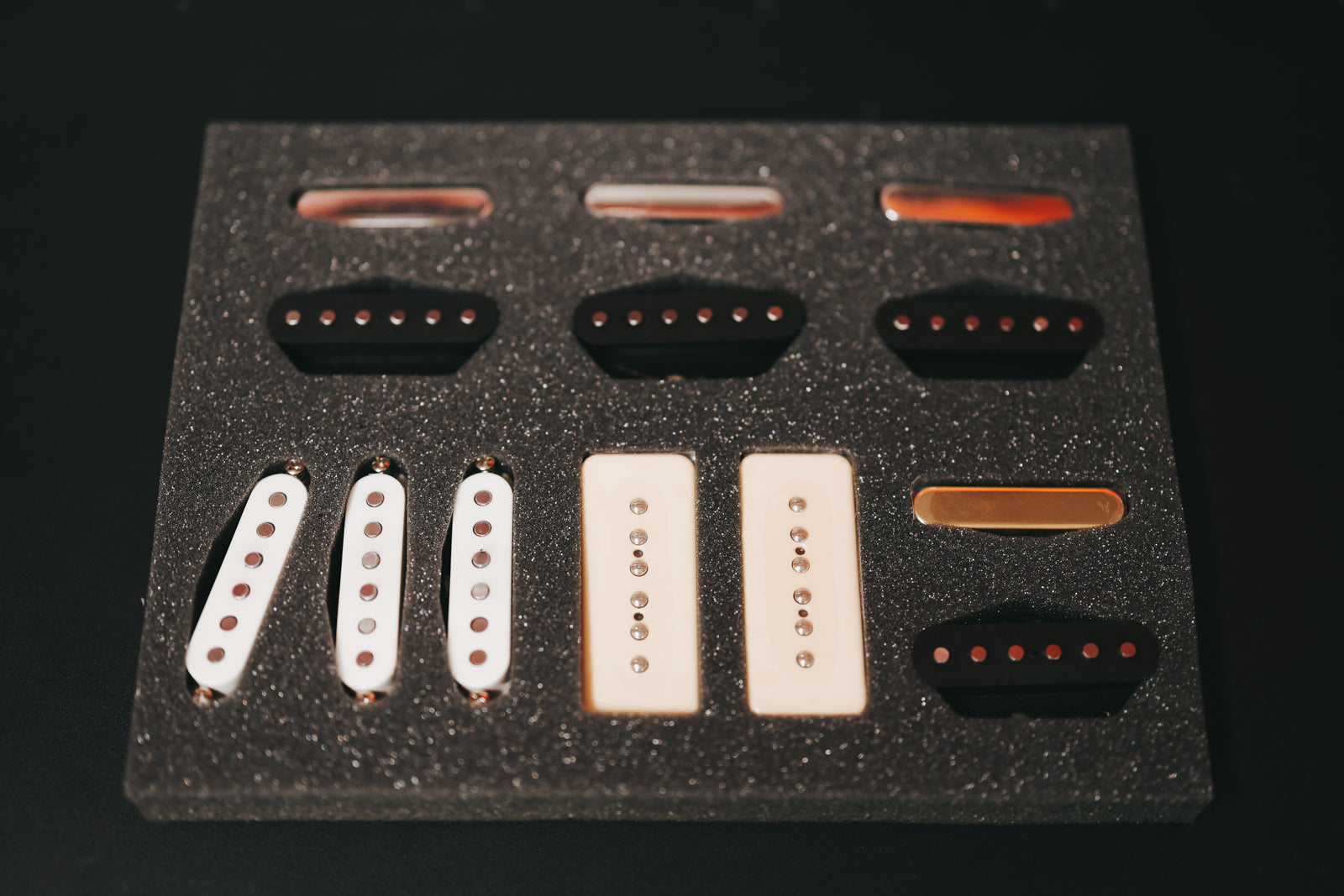
Lets look at the Lambertones Blondie set (Tele-style pickup set) as an example here. The neck stock specs are 5.85k DCR and the bridge is 7.95k DCR. Both pickups have different coil geometries, tensions, total winding-layer counts, winds per layer, and different magnets. Yet they are reverse-wound and reverse-polarity to each other (RWRP). The industry calls that "hum-canceling" and leaves it there, full stop. Technically true. Practically incomplete. My honest answer is yes, but... RWRP tells you cancellation is happening, not how much. Two coils that are RWRP but unmatched still give you real, useful noise reduction. It's just partial, not perfect, and the gap between those two things is physics, not a flaw in anyone's design.
Why This Shows Up on Coil-Split Guitars Specifically
In the case of Sam, he's got a PRS guitar with a coil-split toggle; splitting the pickup down to one coil (or partial split in PRS' case) takes you out of that internal hum-canceling pair, so whether the rest of your wiring stays quiet depends on the relationship between which coils are remaining active and phase is determined if those active coils combined our reverse polarity to each other or not.
Our own V90 set is a good example of the partial-cancellation idea in action. It pairs a P90-style single coil in the neck with our Red Eye humbucker in the bridge, wired RWRP to each other so you can run them together in a combined position. That combined position genuinely reduces hum, but it's partial, not perfect, because a full humbucker's coil resistance and a single coil's resistance just aren't the same animal. Split the humbucker down to one coil and blend that with the neck instead, and the two resistances move closer together, which noticeably tightens the cancellation. Still not identical coils, so still not "perfect" in the humbucker sense, but meaningfully more effective than pairing the full humbucker against the single coil.
That's the piece a lot of players don't realize they're relying on until they swap pickups and the hum either disappears, lessens, or shows back up. It's not bad luck; it's polarity, winding direction, and how closely two coils are matched, all doing exactly what they were built to do, or not.

How We Build Ours
This is the good news part, and it's the part I told Sam once we got this far into it: every Lambertones set is built with the correct RWRP relationship from the factory, matched to the position it's designed for. That matters more than it might sound. Per the cheat sheet above, polarity is the one variable no amount of rewiring can fix, so it has to be right before the pickup ever leaves our shop. Drop it in following our wiring diagrams, and the hum-canceling relationship your original pickups had is preserved.
That said, I'd rather be straight with you than oversell it: on a matched humbucker set, that gets you close to perfect silence. On a combo set like the V90, or anywhere you're pairing a single coil against a humbucker, you're getting genuinely effective, real-world hum reduction, just not the same completeness a matched pair delivers, for the reasons above. Knowing which one you've got helps you set the right expectation before you ever plug in.
Color codes will differ between manufacturers; ours won't necessarily match your stock pickup's wire colors, but that's a labeling difference, not a functional one. Any tech worth their solder will reference the humbucker color-code chart rather than assume colors are universal, and it takes them all of 30 seconds.
Talking to Your Tech
If you're having someone else install your pickups, give them three things up front: which pickups you're installing, that they're 4-conductor, and a link to our wiring diagrams. That's the entire conversation. If you'd rather do it yourself, a digital multimeter will let you confirm continuity and check your work before you ever plug back in, and we've written more about building out a basic guitar tech toolkit if you want to go that route. And if you're ever staring at an unlabeled pickup trying to figure out what you're working with, the cheat sheet above will tell you exactly which of the four outcomes you're dealing with, and whether a wire swap can actually get you where you want to go.
Polarity, phase, and winding direction all sound like the same conversation until you actually need to know the difference, and then it's the whole conversation. Hopefully this one saves you a wire swap that wouldn't have fixed the problem anyway.
Love your tone,
Kurtis @ Lambertones

Written by Kurtis Lamberton

Leave a comment
This site is protected by hCaptcha and the hCaptcha Privacy Policy and Terms of Service apply.